[The Legend of the Alchemist / The Sword Hero’s Footprints]
Book Introduction:
Yang Hao actually swallowed a deity and was forced to become the senior disciple of the Dan-Ding sect, which practices both alchemy and cultivation – how tragic!
Cultivation brought him a harem of women, and refining pills turned him into a love potion shop owner. Goodness!
This is the only sect in cultivation where you don’t need to meditate to cultivate; just swallowing pills can elevate you to immortality – faster than a dream.
In this postmodern era of pill refining, the “Dragon and Tiger Rejuvenating Pill” is no longer impressive. The real highlights are the “Red Lady,” “Golden Touch,” and “Nine Heavens of Fire and Ice.”
Follow Yang Hao as he navigates a path of cultivation full of debauchery and misfortune, striving to create the most unique pill in the world!
This is a humorous and comedic novel with steady updates – just read and laugh along!
Related Information – Major Spoilers, Enter with Caution!
Major Spoilers, Enter with Caution!
Yang Hao is the only commoner student at the elite academy on the planet Laymon. By chance, he swallowed the immortal soul of a practitioner from the Dan-Ding sect, and since then, he has become the sole successor of the sect, embarking on his unique path of alchemical cultivation.
The Dan-Ding sect, also known as the Love Potion sect, is considered a heretical school among various cultivation sects. Though Yang Hao is an upright person, he is forced to consume various love potions for cultivation, constantly harassed by women around him.
Will Yang Hao manage to walk a path of cultivation that is evil yet righteous? Can he create the most unique love potion in the world? All will be revealed in this story.
Volume I – Character Introduction:
Yang Hao: The male protagonist, a commoner student at the elite academy. Though his academic performance is poor, he accidentally swallows an immortal and begins his journey in the Dan-Ding sect.
Hun Yuan Zi: A cultivation expert from several thousand years ago (approximately 1800 AD), known as the last patriarch of the Dan-Ding sect. Framed by villains, his soul resided in a pill until Yang Hao swallowed it. Now, Hun Yuan Zi has made Yang Hao’s dantian his new home and is determined to train him into a great cultivator.
Ais: The campus beauty at Laymon Academy, with half-Angel Star bloodline, making her exceptionally beautiful. Her father is the imperial ambassador to Laymon, giving her a privileged upbringing that has made her spoiled and temperamental.
Amanda: A tall, curvy beauty, though not particularly well-dressed, so her beauty is not widely recognized. She comes from a top mechanical engineering family and is capable of building any kind of machine.
Wang Zhi Jun: A young man from a famous sword-fighting family. His noble background makes him look down on Yang Hao, but he is constantly outmatched in duels, making him eager to call upon his family’s experts to deal with Yang Hao.
Kevin: A noble from the Bear Planet, his fur-covered body resembling a bear. He is Wang Zhi Jun’s follower.
Political Forces:
Galactic Empire: From the year 2500 AD, Earth in the Milky Way established a unified government and began expanding to other planets. After about a thousand years, the empire unified the entire Milky Way, forming the foundation of the Galactic Empire. Over the next two thousand years, the empire rapidly expanded to other galaxies. Due to exponential growth in technology, the empire conquered thousands of galaxies in a short time, reaching the edge of the universe.
Political Forces of the Galactic Empire: The empire adopts a constitutional monarchy. The emperor is the ruler and commander-in-chief of the military, the Imperial Parliament is the legislative body, and the Senate is composed of a group of mysterious elders who serve as the empire’s overseers. It is said that the Senate is the source of the empire’s rapid expansion, and they can depose the emperor at any time.
Colonial Planets: Due to the empire’s vast territory and the limited number of Earth-born elites, not all planets can be directly occupied. Therefore, in some edge systems, the empire maintains control through colonization. For example, Laymon is a typical colonial planet; the empire has stationed troops and an ambassador on Laymon but does not interfere with its existing royal rule. Usually, each system has one significant planet as a colonial hub, radiating control over the entire system.
Imperial Military Composition: The Galactic Empire’s military is complex but can be broadly divided into two types. One is the technology-based soldiers, mainly consisting of fleets, high-tech armed infantry, ground armored units, and long-range attack forces. The other is the martial arts forces, commonly known as swordsmen and martial artists. Generally, the status of swordsmen is higher than that of technology-based soldiers, with a single swordsman said to be able to hold off thousands of ordinary soldiers.
Noble Families: Within the Galactic Empire, there are many powerful families who have become nobles due to their ancestors’ achievements. Most nobles hold important positions in the military. There are also families in the empire that pass down martial arts through generations, holding special status in the military. For example, the Wang family and the Lightsaber sect are among them. The ten most famous sword families are collectively known as the Ten Sword Schools.
Volume II – New Character Introduction:
XII: A super robot created by Amanda, claimed to have an artificial intelligence brain, but in reality, it is a failure. As a robot with human-like personality, XII is very pessimistic and never obeys Yang Hao.
Principal: The principal of Laymon Academy, an important member of the Laymon royal family, and the third in line to the Laymon throne.
Wang Tao: The leader of the Laymon Royal Swordsmen, and Wang Zhi Jun’s older brother. Though officially belonging to the Laymon royal family, he is actually an imperial agent sent to monitor the local royal family, giving him an elevated status.
Zhu Geli: A business genius, claiming to be a descendant of the ancient sage Zhuge Kongming, possessing top-notch intelligence. However, due to his womanizing nature, he spends all his earned money on women and aphrodisiacs.
Li Bo: A young merchant representative, an important force for the Galactic Empire in controlling colonial planets. His “Million Sex” aphrodisiac shop is the most popular aphrodisiac chain.
Ling Ziyan: The female boss of the Ling Fei Star Sea on Laymon, with graceful demeanor and charming appearance. She single-handedly supports the Ling Fei Star Sea, the largest brothel in the galaxy. It is rumored that Ling Ziyan is the final disciple of a certain elder from the Imperial Senate.
Volume II – New Force Introduction:
Laymon Royal Family: The authoritarian ruling force on Laymon, surviving in the cracks of imperial power and maintaining a firm grip on the planet, holding a leadership position in this system.
Merchants: The vanguard force of the Galactic Empire’s external expansion, using commercial trade to aggressively exploit other planets, often referred to as “winged rats.”
Ling Fei Star Sea: The most famous brothel chain in the Galactic Empire, claiming to have at least one branch in every star system, almost monopolizing the entire universe’s sex service industry. In essence, it is also a means for the empire to strengthen its control.
Laymon Capital: The largest city on Laymon, divided into two main parts. The core area is the Imperial City, where the royal family resides separately. The area outside the Imperial City is divided into thirteen major districts. The population of the capital exceeds tens of millions.
Volume III – New Character Introduction:
Shi Mingyuan: Once hailed as the number one courtesan in the universe, but due to an unbreakable electrical defense on her body, she has remained a virgin. The title of the number one courtesan seems more like a joke. Although extremely beautiful, since she cannot accompany anyone to bed, the price for daily viewing is only a few low-value imperial coins.
Golden Beetle: A monstrous creature dominating the planet Suimian, feeding on gold ore, and capable of shooting out golden pearls when attacked. It can secrete precious gold essence over long periods, and its group attack power is astonishing.
Jin De: Deputy leader of the Royal Swordsmen, a famous descendant of the Lightsaber sect from the Ten Sword Schools, known for his powerful “Aurora” technique.
Emperor Danzhen: The supreme emperor of Laymon, who unified the entire planet through military campaigns in his youth. In his old age, his fighting spirit has waned, but his position remains unchallenged.
Volume III – New National Force Introduction:
Lightsaber Sect: One of the Ten Sword Schools of the Empire, as a coalition of several families, holds a relatively high status. The Lightsaber Sect is currently the top sect in private martial arts.
Imperial Guard: The royal family’s direct imperial guards on Laymon, primarily consisting of swordsmen personally trained by the Laymon royal family. Their strength is generally on par with that of regular groups of swordsmen. The Imperial Guard is absolutely loyal to the royal family and represents one of the forces capable of rivaling the imperial stationed army.
Ancient Cultivation Sects: In Hun Yuan Zi’s time, there were many different schools of cultivation, but they were mainly divided into two major schools: Qi Cultivation and Dan-Ding. The Qi Cultivation school focused on sitting meditation and absorbing the primordial energy of heaven and earth, while the Dan-Ding school focused on refining pills. However, the Dan-Ding dual cultivation school was considered a heretical sect recognized by all, and was not accepted by the orthodox path. In the current universe era, all previous cultivation sects have suddenly disappeared. Hun Yuan Zi believes there must be a huge conspiracy behind it.
Volume IV – New Characters Introduction:
General Long: The commander of the Laymon royal guard, tall and imposing, extremely loyal to the royal family, with the family secret technique “Dragon Cannon.”
Empress Ming: The queen of Laymon, born with a noble demeanor, the most beautiful woman in Laymon, who once thwarted a royal rebellion and is considered the second most powerful person in Laymon.
Consort Frost: Emperor Danzhen’s favorite concubine, a beauty brought by Wang Tao from the empire. In reality, she is an imperial spy planted beside Emperor Danzhen.
Volume V – New Characters and Forces Introduction:
Hao Sword Group: A swordsman group composed of orphans adopted by Yang Hao, with Yang Hao as the leader and General Long as the instructor, currently possessing initial combat capability.
Doom Battleship: One of the strongest single ships in the universe, built at the spacecraft base of the Three Crystal Sea star system, gifted by Empress Ming of Laymon to Yang Hao, becoming the base of Yang Hao and the Hao Sword Group.
Holy Bear Planet: The main planet of the Holy Bear constellation, the birthplace of the Bear People, a beautiful light blue planet with lush vegetation, surrounded by three small satellites.
Bear People: High-intelligence beings on the Holy Bear Planet, resembling bears in appearance but with human-like facial features and limbs. The Bear People naturally possess the ability to add power, making them the main source of conscription for the Galactic Empire.
Political System of the Holy Bear Planet: The Bear People are a martial race, with the Great Leader being the sole dictator of the entire planet. Each Great Leader must be determined through strict selection and martial arts contests. The term of the Great Leader is lifelong, and the position is usually held by the strongest martial artist on the planet.
Heavenly Fleet: As one of the four major military families of the Galactic Empire, the Wang family’s greatest asset, boasting a formidable formation of two battleships and four destroyers. A single volley is sufficient to obliterate an entire planet. The King Swordsmen Group aboard the Heavenly Fleet is the most elite martial arts unit in the empire, with every swordsman being a core member of the Wang family.
Wang Mu: Commander of the King Swordsmen Group, commander of the Heavenly Fleet, and an imperial general. He is the foremost swordsman in the Galactic Empire’s military and a top expert in the Wang family. According to intelligence, he should be the father of Wang Tao.
Senate Envoy: A very mysterious combat organization, directly under the Galactic Empire’s Senate, usually composed of the senators’ disciples. Legends say the experts in it possess special abilities and may even be ancient cultivators. The Senate Envoys are spread throughout the universe, and no one knows their true identities. They usually carry out assassinations and intelligence gathering missions, making them the most terrifying assassins.
Situ Hai: A legendary wandering swordsman in the universe, who once saved several planets with just one sword, and has never lost a duel in over a thousand matches. When he was young, he was considered the most powerful challenger to the title of the universe’s top swordsman. Sui Hai is known for his independent and unconventional nature, and he refused the rewards offered by the emperor of the Galactic Empire. In recent years, for unknown reasons, he has become a fallen drunkard.
Master He De: A groundbreaking figure on the Holy Bear Planet, an unparalleled Bear People martial arts master with wisdom surpassing ordinary people. He is revered as the only one who can stand shoulder to shoulder with the elders of the Galactic Empire. After refusing to join the Galactic Empire’s Senate, he returned to the Holy Bear Planet and trained countless top martial artists. In the past century, almost every leader of the Holy Bear Planet has been a disciple of Master He De. It is said that as long as Master He De is alive, the Galactic Empire will never be able to completely control the Holy Bear Planet. Master He De is the living god of the Holy Bear Planet and the spiritual leader of the Bear People.
Volume VI – New Characters and Forces Introduction:
Demon Bear Group: The permanent martial arts group on the Holy Bear Planet, one of the most famous martial arts groups in the universe, and the foundation of the Holy Bear Planet’s standing. Before the emergence of the Galactic Empire, the Demon Bear Group was the most powerful military force in the Holy Bear star system and held a dominant ruling position. The Demon Bear Group’s three arrays and killing formations are considered to be powerful formations of martial arts groups, and no one has been heard to pass through them in the past century.
Delke: The current leader of the Demon Bear Group, the most talented martial artist on the Holy Bear Planet in the past century. He once studied under the legendary figure Master He De and later joined the Black Wind Elder of the Galactic Empire’s Senate. He is one of the strongest swordsmen on the Holy Bear Planet, wielding the Gravity Sword, one of the top ten famous swords in the empire. It is generally believed that Delke’s bid for the position of Great Leader is a concrete step by the Galactic Empire to completely subjugate the Holy Bear Planet.
Holy Bear: The god of the Bear People, in the legendary stories, the Bear People are said to have been born from the Holy Bear. The Holy Bear is divided into two parts: one is the Spirit God, who governs the miracles and powers of the Bear People. The other is the Flesh God, who governs the Bear People’s courage and life. The Flesh God Holy Bear used to live on the Holy Mountain, and what Yang Hao wants is the Flesh God Holy Bear’s gallbladder.
The Battle of the Outer Mongol Left Arm: The most legendary battle in the universe, and also the one the Galactic Empire absolutely does not want to mention. In this battle, the Galactic Empire’s top fleet, the Titan Fleet, encountered rebels in the Outer Mongol Left Arm and was completely destroyed. It is said that there were only two rebels present at the time. This battle was spread throughout the universe by wandering poets and storytellers and became the spiritual pillar for those resisting the empire.
Titan Fleet: Once one of the most outstanding and largest fleets of the Galactic Empire, but it was completely destroyed in the battle of the Outer Mongol Left Arm, with almost all its soldiers and officers killed. However, after this, the emperor of the empire ordered robots to collect the DNA of the dead in the universe and rebuild the new Titan Fleet through cloning techniques. Although the new Titan Fleet no longer has the former glory, it is still one of the coldest fleets in the empire today.
Volume VII – New Characters and Forces Introduction:
Holy Mountain Inner Palace: The palace at the core of the Holy Mountain, originally the place where the divine Holy Bear resided and rested. After the empire used climate weapons, it became a giant ice palace. The remaining Holy Bears hibernate in this ice palace.
Holy Star People: A unique race in the universe, existing in the form of pure spiritual entities. The Holy Star People once controlled the religious systems throughout the universe and used them as tools to control the cosmic regime. However, during the famous “Day of Divine Retribution,” almost all the Holy Star People were killed overnight.
King Thousand Saints: The greatest king in the history of the Holy Star People, who led the Holy Star People to establish cosmic hegemony, but went missing after the “Day of Divine Retribution,” and it is said that he has died.
Maya: Known as the “Light of the Saints,” the princess of the Holy Star People, who was pursued by a mysterious force during the “Day of Divine Retribution” and eventually fled to the Holy Bear Planet, where she was protected by the Holy Bear and has served as the High Priestess to this day.
Volume VIII – New Characters and Forces Introduction:
Divine Race: A special race in the universe, often possessing abilities that surpass those of highly intelligent beings. The Creator and the Maker of Man are also alternative names for the Divine Race. True Divine Race are naturally born tribes and cannot be achieved through cultivation.
Female Cauldron: Materials required for the cultivation of the Dan-Ding sect, using a woman’s body as the cauldron for refining pills, with different bodies offering different effects.
Immortal Union: A woman born from the union between an immortal and a mortal, known as an Immortal Union. Immortal Unions are one in ten thousand, offering special and extraordinary effects as a female cauldron.
Heavenly King Fleet: The Wang family’s private army, one of the three major family armies in the empire, possesses considerable military strength. It includes the King Swordsmen Group, which ranks among the top ten in the empire’s martial arts rankings.
Wang Mu: Commander of the Heavenly King Fleet and leader of the King Swordsmen Group, as well as commander of the Holy Bear Planet combat corps. He is the pillar of strength for his generation of the Wang family, and his “Nightfall” sword technique is unrivaled in the world.
Ten Swords: Ten ancient swords left by ancient sword immortals. It is said that collecting all ten ancient swords can grant the power to dominate the world. Now, the ten ancient swords are respectively owned by the ten sword schools of the empire, becoming the family treasures of various powerful families.
Sorcery: When cultivators reach a certain level, they can use sorcery. However, sorcery must consume excessive amounts of true qi, so it cannot be used excessively.
Imperial Privy Council: Alongside the emperor of the empire and the Imperial Senate, it is one of the three major powers of the Galactic Empire. The Privy Council mainly controls the empire’s major fleets, relying on high-tech armaments for its strength.
Luo Dongjie: A new generation officer of the Privy Council, who has been given important responsibilities and has a marriage agreement with the upper echelons of the Three Crystal Sea star system.
Sunset Fleet: One of the main fleets directly under the empire, with unique Titan ships possessing great power. The Sunset Fleet is stationed near the Holy Bear star system and is incorporated into the corps during the campaign against the Holy Bear Planet.
Volume IX – New Characters Introduction:
Three Crystal Sea Star System: The second technological center of the Galactic Empire, located at the boundary between the core and the periphery of the empire. The Three Crystal Sea Star System consists of three planets, rich in silicon-based minerals. Currently, the Three Crystal Sea Star System has become the hidden center of the anti-empire alliance.
Steve: The governor of the Three Crystal Sea Star System, a second-generation colonist who has begun to lean towards the anti-empire alliance for some mysterious reason. Steve is skilled in calculations and has great political talent, making him a profound and unfathomable person.
Anti-Empire Alliance: As long as the Galactic Empire exists, there will be an anti-empire alliance. When the Galactic Empire’s territory expanded a hundredfold and history passed several hundred years, the alliance also underwent significant changes. From previously just a few heroic individuals rebelling independently, it now has the support of over a hundred star systems, openly possessing its own army and gaining the support of the divine race. The anti-empire alliance has reached the point where it can formally rival the Galactic Empire.
Suffocating Black Hole: One of the most terrifying black holes in the universe. Legends say that no one can escape the suffocating black hole’s suction, even experts like Hun Yuan Zi must rely on the divine race to escape. It is said that all the black holes in the universe are the work of the divine race, with the suffocating black hole being the entrance to the divine race’s hidden world.
Xin Mei: The divine race’s guide messenger, not high in divine power, but possessing astonishing beauty.
Garuda: One of the high-level members of the divine race, capable of transforming into a golden-winged bird. On Earth, it was once worshipped as a Buddha.
Volume X – New Characters and Forces Introduction:
Titan God: In ancient legends, the ruler of the human world. It is said that there are twelve Titan gods, each governing different domains. The Titan gods are also the ancestors of giants and one of the upper divine races in the divine realm.
Cadias Dragon Clan: The most brutal and dark divine race in the universe, also considered the leader of the dark faction of divine races. The dragon clan has many branches, but the Cadias dragon clan is the most orthodox one. According to the differences in power, the dragon clan is divided into red dragons, green dragons, black dragons, and golden dragons.
Dragon Cliff: The location of the dragon clan’s lair. Due to the dark power of the Cadias dragon, a large area of the Dragon Cliff region turns black.
Dragon Breath: The essence of the dragon clan’s power. According to different power attributes, dragon breath has different colors and appearances. In legends, any creature that survives three times of being drenched in dragon breath can possess the dark power of the dragon clan.
Dragon Breath Pill: In ancient times, the ancestors of the Dan-Ding dual cultivation sect created the Dragon Breath Pill at great risk in order to communicate with the dragon clan. However, due to the enormous cost of making this pill, no one was ever able to consume it.
Flash Clan God: The Flash Clan is the most wonderful divine race in this world, the leader of the upper divine races and the light faction of divine races, yet it has no fixed image. It is said that many races’ gods in the human world and the universe are manifestations of the Flash Clan god. The greatest ability of the Flash Clan is to control time; they can freely stop time and make it briefly reverse.
Yun Shang: The leader of the Flash Clan in this divine realm, with a constantly changing appearance. What Yang Hao saw was a fat old man.
Dark Angel: The core force of the dark faction of the divine race, the Dark Angels are considered fallen light angels, with the biggest representative being that the wings of the Dark Angels are all black. However, Dark Angels are the same as light angels in many aspects, such as the distinction of power being the number of wings, and once the wings are cut off, their power is lost.
Satan: The king of the Dark Angels, a leading figure among the divine races who can stand shoulder to shoulder with the Cadias dragons and the Flash Clan. Satan is considered the first fallen Dark Angel and uniquely possesses twelve black wings. The king of the Dark Angels wields the silver Night Axe, whose power can rival that of a great light angel.
Great Light Technique: The ultimate skill of the leader of the light faction divine race, the Great Light Angel, possessing incomparable light power, which is fatally damaging to dark attribute divine races. In the final battle of the Grand Hall, this technique was once used to kill tens of thousands of Dark Angels.
King of the Universe: This is a secret known only to the divine race. Legend says that the Creator chooses a person to become the King of the Universe. This person must endure three ultimate infusions of dark power and three ultimate infusions of light power. Only after completing the transformation in these six trials can one ascend to become the King of the Universe. The Creator’s choice will grant this person power that surpasses everything, even the power of the divine race. After the divine race was sealed into the divine realm, this candidate for the King of the Universe was also considered the savior who could release the divine race.
Related Information – Cultivation and Alchemy Data
Cultivation and Alchemy Data
Theories of Immortality – Paths to Cultivation
Cultivation is a process of transforming an ordinary person into an extraordinary immortal. According to the Taoist concept of physical and spiritual duality, cultivation inevitably focuses on both the physical form and the spirit. Therefore, Taoist practitioners have long explored paths to immortality along the direction of “harmony of body and spirit, unity with the Dao.” However, the paths to cultivation emphasized by Taoists of different generations vary, and the specific methods they have attempted are countless. The main explorations can be summarized as follows.
First, there was the practice of taking medicine, which included obtaining elixirs of immortality from immortal realms and preparing medicinal compounds according to specific formulas. Initially, during the early Warring States period, alchemists mainly searched for elixirs of immortality by visiting places such as the Three Sacred Mountains at sea. By the late Western Han Dynasty, some individuals began to synthesize elixirs artificially. The primary raw materials used were minerals and stones, and the resulting products were often referred to as “Golden Elixir” or “Golden Liquid.” Toward the end of the Western Han and the beginning of the Eastern Han Dynasty, numerous丹经 (Dan Jing, elixir scriptures) were already circulating in society, such as “The Great Pure Golden Liquid Divine Spirit Essence” and “The Yellow Emperor’s Nine Tripod Dan Jing,” indicating that both the theories and techniques involved in elixir-making had already reached a highly advanced level. However, producing elixirs required substantial investment, and since they largely relied on minerals and stones as raw materials, many of these substances and the resulting products themselves were toxic. Alchemists conducted extensive experiments on themselves and others, eventually discovering significant side effects. Therefore, after reaching its peak during the Tang Dynasty, people also recognized its drawbacks. By the time of the Northern Song Dynasty, fewer and fewer individuals dared to consume these elixirs, causing this practice to gradually decline. Alongside the development of elixir-making, another practice emerged involving the use of base metals such as lead and iron to produce “precious metals” like medicinal gold and medicinal silver, known as the “Yellow and White Arts” or alchemy. However, the synthesized gold and silver were only similar in appearance and certain properties to real gold and silver, but not genuine. Both Golden Elixir practices and the Yellow and White Arts eventually declined, but they were pioneers in humanity’s efforts to artificially control material transformations and conduct experimental chemical research, thus occupying an important place in the history of human civilization. For further information, please refer to the relevant sections in this database on “Taoism and Human Civilization.” During the Tang Dynasty and earlier, the Golden Elixir technique constituted the most significant aspect of cultivation arts.
Second, refining qi and guiding techniques. The immortality seekers have long regarded taking and refining qi as the basic means of cultivation. Even when taking golden elixirs, they often combined it with refining qi. In the Warring States period, the famous litterateur Qu Yuan wrote “Far Journey,” which mentioned the method of taking qi. Later, in Taoism, the practice of taking qi developed greatly, including techniques such as refining external qi, visualizing, focusing on a single point, and fetal breathing, which were diverse and rich. Although there were many techniques, these methods of taking qi were adopted as the main or auxiliary methods in Taoism for cultivation. Later, these techniques spread to society and became physical exercises that ordinary people could practice, which is a later development. Another category of methods related to taking qi is guiding and massaging, which were also introduced into the immortality arts as techniques for drawing blood and qi and expelling the old and absorbing the new.
Third, internal alchemy. Internal alchemy evolved from practices involving the circulation and control of qi. During the late Eastern Han Dynasty, Wei Boyang authored the book “Zhou Yi Can Tong Qi,” which integrated the techniques of the Golden Elixir with internal refinement. However, its influence at that time was limited. By the Sui and Tang dynasties, the disadvantages of using external substances in the Golden Elixir technique became more widely recognized. As a result, Taoist practitioners began to focus on cultivating the body’s internal resources—essence, qi, and spirit—to refine an elixir for immortality. This method is known as internal alchemy. The term “internal” contrasts with the traditional Golden Elixir technique, which relied on external substances such as minerals and stones. Many theories and concepts in internal alchemy are derived from traditional Golden Elixir practices, but their fundamental approaches differ significantly. Therefore, the term “internal” is used, while the original Golden Elixir technique is referred to as “external.” Both methods are often called Golden Elixir, Great Elixir, or Golden Liquid Rejuvenating Pill, and whether an alchemical text discusses internal or external alchemy depends on the specific ingredients and techniques described within (often referred to as the Great Medicine in Dan Shu). From the Tang to the Song dynasties, internal alchemy gradually replaced external alchemy and became the mainstream of cultivation techniques.
Fourth, carrying out various religious rituals and spells to help people accumulate merit, ultimately reaching the state of immortality. Taoism has always excelled at performing diverse incantations aimed at averting disasters and invoking blessings for individuals and society. These spells have developed into numerous specific yet commonly practiced rituals. Within Taoism, these are referred to as “Ke Yi” (ritual codes) or “Ke Fan” (ritual models), with “Zhai Fa” (purification rituals) and “Jiao Fa” (offerings to the gods) being the primary forms. Collectively, they are commonly known as “Zhai Jiao,” covering a wide range of ceremonial practices. These rituals serve as the primary means of communication between humans and spiritual beings. Taoist practitioners believe that engaging in these rituals benefits the people while simultaneously helping practitioners accumulate merit for themselves. Through sincere and prolonged practice, one can ultimately attain the Dao.
During the Song and Yuan dynasties, Zheng Suonan wrote in “Tai Ji Ji Lian Nei Fa” (a rite for saving the deceased, mainly involving the priest’s power and the magical effects of spells to cleanse and refine the deceased with water and fire, achieving harmony of form and spirit, unity with the Dao, and ascension to heaven): “When one firmly believes and concentrates wholeheartedly, one begins by accumulating merit and ultimately attains the Dao.” He also stated: “May those who deeply and consistently practice this salvific ritual be safeguarded from all calamities; may those who aspire to immortality swiftly achieve it. Eventually, all will transcend and reach the ultimate Dao.” When Zheng Suonan spoke of swiftly achieving immortality and realizing the Dao, he was emphasizing the profound influence that performing rituals for others has on the practitioners themselves, ultimately enabling them to fulfill their spiritual aspirations and join the ranks of the immortals.
Fifth, establishing great achievements in the world while not forgetting one’s roots, and after achieving success and retiring, one can also become an immortal, or be deified after death. Many who are enshrined in the ancestral temples of various dynasties, such as Guan Di, Dou Tian Da Di (Zhang Xun), and Yue Yuan Shuai (Yue Fei), are examples of those who became deified through their merits.
It should be pointed out that although there are various distinctions in Taoist cultivation methods, in actual cultivation practices, they often combine and complement each other. Moreover, no matter which type of cultivation technique one engages in, the practitioner must cultivate their mind, follow the Dao, and accumulate virtue, constantly examining and restraining their body and mind to make their hearts pure and free of distracting thoughts, and to do good in the world. Strictly speaking, the several basic cultivation methods mentioned above belong to the realm of “techniques,” while the cultivation of virtue and morality discussed here is the moral requirement. Only by combining both can one achieve the great Dao.
Inventions on the Alchemy Furnace
(Seeking immortality, chemical experiments in the smoke and fire of refining external elixirs, and the accidental invention of gunpowder)
As is well known, gunpowder, along with papermaking, printing, and the compass, is celebrated as one of the four great inventions of ancient China. It later spread to Europe via the Arab world and played a significant role in the development of human civilization. However, even today, many people may not know that gunpowder originated from the alchemy furnaces of Chinese Taoist priests or that its invention is related to Taoist alchemical techniques. To understand this issue, we must first delve into the history of Taoist alchemy.
First, seeking immortality through the refinement of external elixirs
Taoism is a religion that values life, cherishes life, and emphasizes techniques. One of its core beliefs is the pursuit of longevity and immortality. In reality, people are destined to die, and longevity and immortality are merely beautiful wishes. However, in Taoism, the pursuit of longevity and immortality is a central tenet. Is there a method to achieve this? Taoism tells us: Yes. Refining external elixirs for consumption is one of the specific and primary methods they adopted.
Before the emergence of Taoism, there were already signs of the practice of refining external elixirs. As early as the Spring and Autumn and Warring States periods, people pursued longevity and immortality by exploring various ways to prolong life. At that time, people thought: the main cause of normal human death is illness; if one does not get sick, can one live forever? Medicine can cure diseases, so is there a panacea that can cure all diseases and prevent illness, thus achieving longevity and immortality? Immortals can live forever because they must have consumed the elixir of immortality, so if we can get along well with immortals, we can share their elixir of immortality. Thus, during the Warring States period, many alchemists went to the three mythical mountains of Penglai, Fangzhang, and Yingzhou on the coastal areas of Yan and Qi to search for the elixir of immortality. In the south, according to records in the “Strategies of the Warring States” and “Han Feizi,” there were also people who presented “elixirs of immortality” to the King of Chu. Later, the First Emperor of Qin and Emperor Wu of Han spared no expense in large-scale searches for immortals and sacrifices to gods in pursuit of the elixir of immortality, with predictable results. Did the elixir of immortality exist? Could humans truly communicate with immortals?
At this time, people noticed that some herbs and minerals could cure diseases and prolong life. However, the pursuit of immortality through alchemy was not just about physical health; it was also about spiritual transcendence. The Taoist priests believed that by refining and consuming these substances, they could achieve a state of immortality, merging their physical and spiritual selves into the Dao.
The alchemical practices of the Taoist priests involved complex processes of selecting, purifying, and combining various substances, often under strict ritual conditions. These substances included minerals like cinnabar (mercuric sulfide), gold, silver, and various herbs. The goal was to transform these base materials into a perfected elixir that could grant immortality. However, many of these substances were toxic, and the pursuit of immortality often led to illness or even death. Despite this, the practice persisted for centuries, driven by the deep-seated belief in the possibility of achieving immortality through alchemical means.
The invention of gunpowder, while not the intended goal of these alchemical experiments, was a significant byproduct. The Taoist priests, in their quest to create the perfect elixir, experimented with various combinations of substances, including saltpeter (potassium nitrate), sulfur, and charcoal. These were the key ingredients in the eventual formulation of gunpowder. The discovery of gunpowder was likely accidental, occurring during the heating or mixing of these substances in the alchemical furnace. The explosive properties of the resulting mixture were quickly recognized and put to use in various applications, from fireworks to military weapons.
The development of gunpowder marked a turning point in human history, revolutionizing warfare and eventually leading to the development of modern explosives and firearms. The accidental discovery of gunpowder through the alchemical practices of the Taoist priests is a testament to the ingenuity and persistence of ancient scientists, even in their pursuit of seemingly mystical goals.
In conclusion, the history of alchemy in ancient China is a rich and complex narrative, intertwining the pursuit of immortality with the practical application of chemical knowledge. While the goal of achieving immortality through alchemical means was never realized, the legacy of these practices lives on in the form of gunpowder and the broader field of chemistry. The Taoist priests, in their quest to unlock the secrets of life and death, inadvertently laid the groundwork for one of the most transformative inventions in human history.
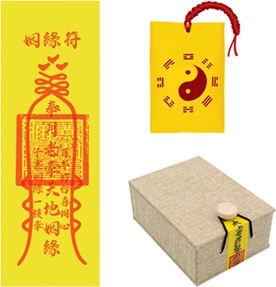 Tai Sui Yellow Amulet Paper FuLu Taoist Love Talisman Traditional Chinese Spiritual Charm Attracting Love Protecting Marriage