The blossoms part, each telling its own tale. Let us now speak of Old Woman Fan, who, in a fit of beastly frenzy—no, wait, that’s not right—should rather be said to have displayed her divine prowess. For two or three consecutive days, she resolved several haunting incidents. But what happened next left everyone stunned once again. Why? The dam had nearly been completed, yet the river began to dwindle. At first, it was still a zhang wide, but soon it shrank to merely a chi in width. The farmland cracked like dried earth, and crops withered before they could be watered. Even stranger still, whenever dark clouds gathered, as soon as they passed over Xiushui Village, they vanished into thin air—not even a wisp remained.
Village Chief Tian was beside himself with worry, pacing in circles, and even considering personally heading to the town to ask the military to bring in anti-aircraft guns for artificial rainmaking. But how could you make rain without clouds? With a sky as clear as polished glass, where would you even aim the guns?
Water scarcity—a problem that had once seemed as distant as the stars—now brought frowns and furrowed brows to every villager’s face. Liu Dashao suddenly recalled a line from an old book at home: “When the Hanba appears, a thousand miles turn to dust!” This ancient book, not inherited from his father or grandfather, had actually been a gift from Old Woman Fan upon his apprenticeship. It was titled *Zhengyi Fu Suan*, filled with classical Chinese, much of which he couldn’t understand. Yet it contained many strange and wondrous things, and children naturally love the bizarre. Thus, Liu Dashao had been reading it diligently these days, even going through a phase where he couldn’t bear to put it down.
In this *Zhengyi Fu Suan*, there was indeed a record of the monster known as “Hanba.”
The so-called Hanba is essentially a type of zombie. Wherever a Hanba appears, drought follows—no rain will fall. Tracing the origins of Hanba, one must go back to ancient times. According to folk legend, the Hanba first appeared during the grand and bloody war between the Yellow Emperor and Chi You, a battle between gods and men.
Both sides deployed every possible force. Chi You’s brothers were born with superhuman strength, their heads and bodies as hard as copper and iron. They could command fierce beasts, venomous insects, and spirits. On the Yellow Emperor’s side, the Wind Master and Rain Master led the charge, summoning celestial and terrestrial spirits and ghosts. Most terrifying of all, the Xuanyuan clan even summoned zombies from foreign lands—transformed into Hanba—to join the battle. In myths, the Hanba was hideous: green eyes on the top of its head, hair made of writhing snakes, and a body covered in white, steel-like fur. Its power was immense. Wherever the Hanba went, not a single drop of rain would fall, often causing a three-year drought, turning the land into a barren wasteland where all life withered and died.
But these are merely legends. Real zombies are not so exaggerated. The most widespread tales of zombies come from the tradition of corpse-moving in western Hunan—also known as spirit-moving, shadow-walking, or corpse-walking. It belongs to the Maoshan School and the Zhuyou branch of Taoism, originating in the four counties of Yuanling, Luxi, Chenxi, and Xupu. Because much of this region is mountainous and difficult to traverse by vehicle, the profession of corpse-moving emerged. Usually, the corpses are still fresh when the practitioners begin moving them back to their hometowns for burial.
The corpses moved in this way are known as “walking corpses.” Those who perform this practice are referred to as “corpse-movers” or “corpse-guides.” Typically, they transport the corpses before dawn, leading them to a mortuary or a designated shop. There are numerous peculiar methods of moving corpses: floating corpses,背 corpses, flying corpses, and even corpses contained within jars—so bizarre that they have given rise to countless horrifying zombie legends.
The corpses are generally wrapped in wide, black funeral cloths, wearing tall felt hats, with yellow talisman papers covering their foreheads and hanging down over their faces. In front of these black-cloaked corpses walks the corpse-mover, holding a copper gong. He strikes the gong with one hand and leads the line of corpses forward, chanting: “Dust returns to dust, earth returns to earth. Life is hard indeed. Zombie, zombie, follow me home, return to your native land and descend to the underworld.”
The corpse-mover does not carry a lantern, but instead shakes a soul-summoning bell to warn travelers to stay away and alert households with dogs to lock them up. If there are more than two corpses, the corpse-mover strings them together with straw ropes, each spaced seven or eight chi apart. Another theory claims that the reason these corpses can be moved is due to a herbal medicine from the Miao ethnic group, applied to the mouth and nose of the corpse during the intermediate state between death and rebirth. This allows the corpse to walk like a living person at night, though it cannot speak or think, and obediently follows the commands of the corpse-mover.
Since ancient times, the profession of corpse-moving has existed in western Hunan. To learn this trade, one must meet two conditions: first, one must be brave; second, one must be physically strong. Moreover, one must apprentice under a master. Corpse-movers do not take apprentices lightly. Prospective apprentices must first have their parents sign a written agreement. Then the master conducts an interview. Generally, the applicant must be at least sixteen years old, over 1.7 meters tall, and must meet one unusual condition: he must have an ugly appearance. The master begins by asking the applicant to stare at the sun and then spin around. Suddenly stopping, the applicant must immediately identify the cardinal directions. If he cannot, he is rejected, for if he cannot tell directions at that moment, he would be unable to guide corpses at night. Next, the master tests the applicant’s ability to find objects and carry burdens. After all, corpses are not living people. On steep slopes, the corpses cannot climb, so the corpse-mover must carry each one up. Finally, there is one last test: the master places a tung leaf on a grave in the deep mountains, and the applicant must retrieve it alone in the dark. Only after passing all three tests can one qualify as an apprentice corpse-mover.
Moreover, a corpse-mover must master thirty-six skills before he can guide corpses. The first is the “Standing Skill”—the ability to make a corpse stand up. The second is the “Walking Skill”—making the corpse walk and stop at will. The third is the “Turning Skill”—enabling the corpse to turn corners. Other skills include “Descending Skill” (for downhill movement), “Bridge Crossing Skill,” and “Silencing Dogs Skill.” The “Silencing Dogs Skill” ensures that dogs along the way do not bark at the corpses. Since corpses fear barking dogs, if a dog barks or bites, the corpse will be startled and unable to defend itself, often ending up torn apart. The final skill is the “Soul Returning Skill.” The stronger this skill, the more the soul returns to the corpse, making the corpse easier and more obedient to guide.
In daily life, a corpse-mover lives like any other farmer, working from sunrise to sunset. Only when a corpse-moving task is assigned does he dress up and set out. Though they practice this profession, they avoid using the term “corpse-moving.” Thus, when insiders request their services, they might say, “Master, could you please take a little walk?” or “Could you go on a journey?” If the corpse-mover agrees, he takes out a special yellow paper and asks the requester to write the deceased’s name, birth date, death date, and gender on it. Then he draws a talisman and sticks it onto the paper, which he then keeps on his person. The attire of a corpse-mover is also distinctive: regardless of the weather, he wears straw sandals, a long blue robe, a black sash around his waist, and a blue cloth cap. Hidden in his sash is a pouch of talismans. When a master teaches an apprentice, the first lesson is drawing talismans—unusual symbols drawn with vermilion ink on yellow paper, part writing, part drawing. When unexpected situations arise on the journey, these talismans are hung on trees or doors facing west, or burned into ash and swallowed with water.
In western Hunan, there is a saying: “Three Corpses May Be Moved, Three May Not.” Corpses of those who were beheaded (provided their heads are sewn back on), hanged, or died standing in a cage may be moved. The reason is that these individuals died unwillingly, longing for their hometowns and loved ones. Through magical rites, their souls are summoned and sealed within their corpses with talismans, then guided by spells to return home, even crossing rivers and climbing mountains.
However, three types of corpses may not be moved: those who died of illness, those who drowned or hanged themselves voluntarily, and those struck by lightning or burned beyond recognition. The first category—those who died of illness—have already lived out their natural lifespans. Their souls have been taken by the Yama officers to King Yama’s court, and no spell can summon their souls back from the underworld. As for those who drowned or hanged themselves, their souls have been “replaced” or “taken as substitutes.” These souls may already be in the process of finding replacements. If a new soul is summoned, the old soul cannot find a replacement, which would hinder its rebirth. In the underworld’s punishment system, King Yama holds a deep disdain for those who do not value their own lives and deliberately end them. Even if they did no evil in life, they are generally not allowed immediate rebirth but must wait until someone else with a similar fate appears. This may take a long time, so some of these suicidal spirits may resort to despicable means, driving others to lose their minds and commit suicide—what is known as a ghost seeking a substitute.
As for those struck by lightning, they are usually those burdened with grave sins. Those burned to death often have incomplete bodies, making them unsuitable for movement as well. This is understandable. According to the teachings of the Esoteric School, there are two types of people who do not enter the intermediate state (the transitional period after death): the supremely virtuous, whose souls ascend directly to heaven and join the ranks of the immortals; and the supremely wicked, whose souls plunge directly into the eighteenth level of hell, suffering endless torment. Thus, those who die violently often suffer from past-life karma, and even skilled practitioners cannot help them.
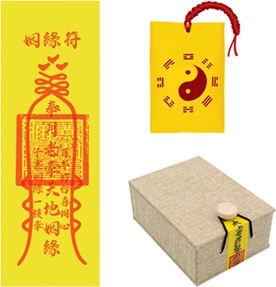 Tai Sui Yellow Amulet Paper FuLu Taoist Love Talisman Traditional Chinese Spiritual Charm Attracting Love Protecting Marriage