The sky was still dark when Mu Lin returned to his apartment. The three girls were still waiting for him in the room without rest. Seeing Mu Lin back, they all involuntarily sighed in relief. Witnessing this scene, Mu Lin couldn’t help but feel a twinge of tenderness and silently embraced the girls. Instinctively, the girls tightened their arms around Mu Lin’s body, reluctant to let go for a long time.
The next day, after a brief period of dual cultivation, Mu Lin appeared at the dining table with renewed vigor. After Mu Lin explained everything to them, the girls finally put down their burdens and looked radiant. The two young female officers also arrived early at the table, clearly having packed their luggage and moved into the villa.
After breakfast, Mu Lin returned to his clinic’s office to continue treating patients. The financial transfers were arranged by Fenny and the others through their Swiss bank account. Mu Lin had handed over his personal account to Fenny and the others for management. Then, the girls each went off to attend to their own affairs. The two young female officers officially took on the reception duties at the clinic today, and after receiving the day’s patients, they returned to their office.
A gang in Chinatown had been wiped out overnight, causing a huge uproar in the underground world of New York and leaving everyone on edge. These people who lived by the blade were used to violence and bloodshed every day; they wouldn’t be frightened by the mere destruction of a gang. The real reason for their fear was that Mu Lin had used a few idiots and a group of weaklings to scare them. Once they lost the strength they relied on to survive, they would become worse than dogs in this world governed by bloodshed and power. If they were to become like those fools again, they might as well commit suicide earlier.
Mu Lin’s non-lethal methods completely shocked Chinatown. Taking the opportunity, the Lion Gang retook control of the Tiger Gang’s territory and publicly announced that it was done by a secret organization that had decided to eliminate the Tiger Gang because of their distasteful behavior. As a result, the five major gangs in New York that had direct or indirect ties with the Tiger Gang temporarily ceased their activities. The entire city’s public security situation improved dramatically, and some of the worst criminals in the underworld, terrified by these developments, simply fled the city.
When the Police Chief, who had come to Mu Lin for treatment, chatted with him about these events, he couldn’t help but marvel at the existence of such an organization—a mysterious group that was more effective than the entire New York police force. If he had known about them, he would have definitely recommended the mayor to award them the “Good Citizen Award.”
When the Police Chief saw the two young female officers, Sara and Stephanie, working as secretaries for Mu Lin, he first congratulated them on finding a good job, believing it would help them build a better relationship with Mu Lin in the future. He also informed them that their suspension had ended and that they could return to the police station anytime if they no longer wished to work for Mu Lin. If he had known the real reason the two young female officers had come to Mu Lin, he would have tried to get them back to the police station immediately to prevent them from causing even more trouble.
When Mu Lin heard these news, he couldn’t help but laugh in disbelief. The Lion Gang really knew how to create trouble for themselves—why make up some organization for no reason? Were they trying to scare children? Everything seemed to be returning to normal again.
Actually, Mu Lin quite enjoyed this leisurely lifestyle. He could spend his days flirting with beauties, practicing his cultivation, and when there was work to do, he would just give a few needles to a bunch of useless people. Then he would attend some romantic and elegant banquets, chatting and joking with some bigwigs to maintain relationships. The only slight regret was that Meifang and Meizi sisters hadn’t started their vacation yet, and Krill and the others also didn’t have time to come over.
With nothing else to do, Mu Lin decided to refine some more pills. This was definitely not the kind of pill refining practiced by ordinary Taoist priests in the mundane world. Speaking of mundane alchemy, it refers to the ancient methods used to pursue “immortality” by refining pills. This practice originated very early in China. According to the “Biography of Liu Xiang” in the “History of the Han Dynasty,” Prince Liu An of Huainan mentioned in his book “Zhen Zhong Hong Bao Mi Yuan Shu” that during the Warring States period, Zou Yan had the “Chong Zhui Yan Ming Fang,” which might be the earliest known pill formula in ancient China.
However, this formula was never passed down to the world, and Liu An’s book has long been lost, so its content is now impossible to verify. However, the “Strategies of the Warring States” records an incident where a Taoist priest presented the King of Chu with a “pill of immortality,” and the “Records of the Grand Historian” provides a detailed account of Emperor Qin Shi Huang’s quest for “immortal pills” and his dispatch of Taoist priests like Xu Shi (Fu) with thousands of boys and girls to the sea in search of “immortals,” clearly indicating that alchemy was indeed prevalent in China during the pre-Qin period. By the Western Han Dynasty, Emperor Wu Di Liu Che pursued immortality with even greater scale, following the suggestion of Taoist priest Li Shaojun to set up an alchemical stove in the palace and personally engage in the refining of pills. From then on, the practice of alchemy began to flourish among the feudal ruling class and persisted for a long time, continuing its development even into the Song and Yuan dynasties and beyond.
Thus, throughout history, many alchemists who practiced the art of pill refining emerged—these are what we now call alchemists. The ancient mundane alchemical practices involved many different fields of natural science, but their main content could be summarized into the following three areas:
First, the research on creating longevity medicine using various inorganic substances, including minerals and metals, through chemical processing; second, the metallurgical research aimed at creating artificial “gold” and “silver” for medicinal purposes; third, the study of medicinal plants in search of plant-based longevity remedies.
The goal pursued by mundane alchemy was immortality, and most of its theoretical basis was based on wild guesses. Since it did not receive genuine instruction from real Taoist practitioners, it became a case of one mistaken belief leading to another, resulting in outcomes that were completely off track.
The methods of alchemy in ancient China could be divided into two main categories: fire methods and water methods. The fire method primarily referred to anhydrous heating techniques with metallurgical characteristics. In the Eastern Han Dynasty, the alchemist Wei Boyang mentioned in his book “Zhou Yi Can Tong Qi” that there were six hundred chapters in the “Fire Record” at that time, which discussed this fire method. However, this book has long been lost, and its content is now impossible to verify. The fire method generally included techniques such as calcining (prolonged high-temperature heating), smelting (heating dry substances), roasting (localized heating), melting, distilling, sublimation (also called “flying” or “ascending”), and “fusing” (heating to change the properties of the medicine).
The water method of processing medicinal substances included the following approximate techniques: dissolving (sometimes also referring to melting), rinsing (using water to dissolve part of a solid), sealing (enclosing reaction substances for long-term storage or burying them underground), boiling (heating in large amounts of water), stewing (prolonged high-temperature heating with water), nurturing (prolonged low-temperature heating), fermenting (long-term storage in a moist or carbon dioxide-rich environment), spotting (using a small amount of medicine to cause changes in a large quantity of substances), pouring (pouring out the solution to let it cool), soaking (cooling the outside of the container with cold water), and filtration and recrystallization.
If modern people were to look at these steps, they would basically realize that this was not alchemy at all—it was essentially conducting chemistry and physics experiments. This is also why it eventually gave way to herbal medicine after being popular for over a thousand years. It was somewhat of a fortunate outcome. In fact, the so-called pill refining by real Taoist practitioners was essentially the preparation of medicinal pills—specifically, pills made from herbal ingredients that could enhance various bodily functions. The several pill scriptures that Mu Lin obtained during his travels and the alchemical techniques passed down by his great-uncle were all based on this principle. Otherwise, Mu Lin would never have eaten those things, even if he were beaten to death.
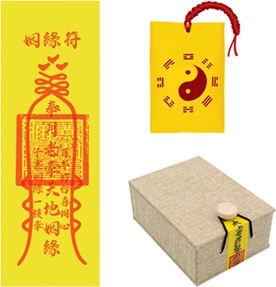 Tai Sui Yellow Amulet Paper FuLu Taoist Love Talisman Traditional Chinese Spiritual Charm Attracting Love Protecting Marriage