The student apartment assigned to Mulin was a quad, with each occupant having a private bedroom equipped with a bathroom and shower, while sharing a common living room and, surprisingly, a kitchen. Other students’ apartments weren’t as well-equipped.
After a week of living there, with registration for the new semester just a day away, Mulin hadn’t seen any roommates move in, which puzzled him. Were they not registering? He shrugged it off.
A week of dining hall food had killed his appetite. Having been in the U.S. for nearly a year, Mulin was tired of American cuisine. Influenced by waves of immigration, American food culture is a melting pot of global flavors, reflected in diverse restaurant menus. Characterized by high fat, sugar, salt, and protein, it’s no surprise obesity is common. Nutrition is emphasized, and with vast land, favorable climates, abundant food varieties, efficient transportation, and excellent refrigeration, chefs and home cooks have endless choices. Americans love salads, often made with fruits like bananas, apples, pears, pineapples, grapefruits, or oranges, or vegetables like celery, potatoes, or lettuce, dressed with salad oil, sauces, or fresh cream for a fresh taste. Fried dishes like fried chicken, bananas, or apples are staples, while puddings and apple pies, though inspired by British cuisine, have evolved into distinctly American versions.
American baked goods are renowned for their preparation and decoration, and cold drinks, frozen desserts, salads, American steaks, and fried chicken are popular even in Europe. Americans don’t drink much tea, preferring iced water or mineral water, and often treat whiskey or brandy like tea, without needing snacks. Chinese food in the U.S., like many imported products, is affordable but altered to suit local tastes, losing authenticity. Chinese restaurants are common on U.S. streets, alongside establishments offering Italian, French, Spanish, and other global cuisines. Regional American dishes also shine, like New England’s clam chowder, Pennsylvania’s game meat pies, Louisiana’s gumbo, Southwestern barbecued ribs, and Southern roasted corn, all famous in their own right.
U.S. restaurants typically come in three forms: buffets, where customers serve themselves from a variety of hot and cold dishes and pay at the counter; formal restaurants, ranging from affordable diners to luxurious establishments; and fast-food joints, ubiquitous in cities, serving fries, pizzas, burgers, fish sandwiches, or roast beef sandwiches.
But no matter how good these were, they couldn’t compare to the rich history of Chinese cuisine. Mulin decided to use the apartment’s kitchen to cook and soothe his rebellious stomach. During his three years of wandering, he had trained as a chef for nearly three months at several restaurants, claiming he had “graduated” as a chef.
After buying ingredients at the supermarket, he returned to the apartment. Along the way, students pointed and whispered, but he ignored them. Back home, he cooked three dishes and was about to eat when he heard a key in the door. His divine sense scanned—three women! Mulin froze.
The door opened, and three chatty girls entered. “Wow, it smells amazing!” “Little junior, you can cook? That’s awesome!” “Now we don’t have to eat at the dining hall!”
One was tall, with flaxen hair tied high, strands framing her face, wearing a light black dress. Another, curvy, had blonde hair in a ponytail and wore casual jeans. The third, petite, had shoulder-length black hair, dressed in a light blue short-sleeve shirt and matching pants. All three wore exaggerated expressions.
Mulin, stunned, asked, “And you are…?”
“Hi, little cutie! We’re your roommates and your seniors!” they chirped.
“No way!” Mulin jumped. His two sisters already gave him headaches; three more might be the death of him. “I’m calling the professor!” He rushed to his room, dialed the apartment manager, who confirmed the professor’s arrangement.
Mulin called the professor. “Professor, how could you put me with three girls?”
“Daniel, you have no family here, and you’re so young. I specially arranged through the college for three nice girls to look after your studies and life. Are you still unsatisfied?”
“No, no! Thank you, Professor!” Mulin hung up, shaking his head with a bitter smile. “Ugh, that old man got me again. And I owe him one. What is this mess? Who did I offend? I should’ve just bought a house and lived alone!” Grumbling, he walked out to greet his new roommates and eat.
At the dining table, he froze: the three girls were fighting over the dishes, each with a plate, using knives, forks, and spoons to snatch food from one another. Only when they finished did they notice Mulin. They stood, saying in unison, “That was delicious! I’ve never had Chinese food this good. Thanks, junior! But we’ll pay you!”
The tall one said, “I’m Fenny, a third-year computer science major in the engineering school.”
Pointing to the curvy one, “That’s Celia, a third-year management major in the business school.”
Pointing to the petite one, “This is Kelly, a third-year internal medicine major in the medical school. We’re your roommates. So, aren’t your seniors pretty?”
Mulin scanned them. They were indeed campus beauties, even Kelly, the shortest, was taller than him. He nodded helplessly. “Hello, seniors. Nice to meet you. Could you move aside? I haven’t eaten yet and need to cook.”
“Oh, awesome! We’re not full either. Can you make more?” they asked. Mulin was speechless.
After eating again, they grew familiar. Mulin’s role as head chef was cemented, and the girls began explaining things new students needed to know, like obtaining syllabi and textbooks.
In U.S. undergraduate education, the syllabus is crucial. Each course has a detailed syllabus, serving as a key teaching document, a guide for instructors, and a roadmap for students. Some universities upload syllabi to their online resource libraries, accessible only to registered students with login credentials.
A syllabus typically includes course objectives, teaching methods, assessment requirements, textbooks, references, and detailed content for each class session. Instructors write the syllabus and distribute it during the first class. Both teaching and studying follow the syllabus, and instructors rarely alter its content or schedule, as deviations could negatively impact course evaluations.
While syllabi follow a similar format, their detail varies. Some are 5–6 pages, others over 10. Some list only session topics and required readings, while others detail discussion points and learning objectives. Syllabi evolve, with instructors updating content based on their research or academic advancements.
Textbooks are essential learning materials, with instructors listing at least 2–3 core books per course, plus numerous reference books and dozens of articles from newspapers or journals. Some instructors compile key chapters or articles into course packs, sold through bookstores or departments to cover costs. Others distribute new articles during the term to keep up with academic developments. One course might recommend up to 36 monographs.
Instructors also provide photocopied reading materials for upcoming classes. A single 2.5-hour class might require 20–30 hours of reading. Consequently, U.S. college students face heavy academic pressure, spending much of their time on required readings to participate in discussions, group activities, assignments, and exams. Without thorough reading, passing midterms or finals with good grades is nearly impossible.
Textbook supply is market-driven. Universities have bookstores managing textbook procurement and sales. At the semester’s start, they sell new and used books (the latter from past students at a third or half the price). After the semester, they buy back used textbooks and stock new ones for the next term.
Initially, the three girls were upset about sharing an apartment with a male, but learning he was a 14-year-old boy, they felt the professor had made them nannies and were negotiating with him. Discovering Mulin buying groceries led to the lunchtime scene.
Learning Mulin was triple-majoring, they promised to handle his textbooks. Though they bought stacks of books, it wasn’t expensive, especially since Mulin, on a school grant, seemed indifferent to money. This piqued their interest in his research.
Seeing their wolf-like stares, Mulin felt like Little Red Riding Hood, wary of getting too close. The more reserved he was, the more enthusiastic they became, occasionally teasing him with flirtatious charm. Mulin groaned inwardly, “I’m doomed—stuck in a wolf’s den!”
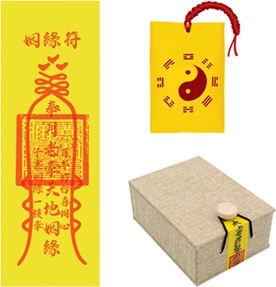 Tai Sui Yellow Amulet Paper FuLu Taoist Love Talisman Traditional Chinese Spiritual Charm Attracting Love Protecting Marriage