As the old saying goes, when you’re in a good mood, everything looks pleasant. Thus, even the rainy day, which Liu Dashao had previously cursed relentlessly, now seemed poetic and picturesque, even exuding a faint touch of petit-bourgeois sentiment (a typical case of pretentiousness).
Raindrops pattered ceaselessly against the glass window as Liu Dashao dozed lazily in his chair the entire afternoon. When he finally awoke, thirsty and groggy, reaching out to find his teacup on the table, he realized it was already the hour of the monkey (3-5 PM).
Straightening his suit, he yanked open the rusty drawer and rummaged through it for quite some time before finally uncovering three uneven incense sticks hidden beneath several basketball magazines. He then turned and walked toward the shrine behind him. Though small, the shrine was exquisitely decorated, crafted entirely from fine vermilion wood, and even the incense burner gleamed with golden brilliance, quite majestic indeed.
On both sides of the shrine, flickering candle flames danced, sending up thin curls of smoke. Oddly enough, instead of statues of deities or Buddhas, there was a pencil-drawn cartoon portrait of an old Taoist priest. Unfortunately, the artist’s skill was questionable at best—every line was uneven, the entire image crooked and messy, like the scribbling of a three-year-old. One could barely discern that the figure was male, with a beard, and little else.
Beneath the cartoon drawing rested a memorial tablet inscribed in elegant, flowing calligraphy: “Spirit Tablet of Zhang Enpu, the 63rd Generation Taoist Master of the Celestial Masters Sect.”
The inscription was lengthy and awkward to read, but since it was enshrined here and offered incense, it must have had a deep connection with the protagonist.
What? You’re curious why such a solemn shrine would display a cartoon sketch? Alright, let me explain.
As Liu Dashao himself explained, when his cheap master passed away, photography was still unknown in the countryside, let alone taking photographs. Thus, no proper portrait could be made, so he had to draw one himself based on memory. After all, as the saying goes, if you want something done well, you must do it yourself. What? You say that’s not a real person? Don’t you know Liu Dashao studied abstract art? That’s right—just like Picasso.
Lighting the incense stick from the candle flame, Liu Dashao gave a perfunctory bow toward the central tablet: “Master, it’s time for dinner. Business has been bad these past two days, so you’ll have to eat a little less. Once I get work tomorrow, I’ll immediately buy you a pound of braised duck wings from the duck restaurant.”
“Zhi zhi…” At the mention of duck wings, Liu Dashao’s appetite was instantly stirred. He rubbed his greasy hands together, drool nearly dripping from his mouth. That new duck restaurant next door—its dishes paired with wine were simply amazing! Even immortals would stop in their tracks, and the Jade Emperor himself would descend from heaven for a taste. Let alone a fence-sitter like him.
“Hehe, as usual, I’ll eat, and you can just smell it.”
“Besides, you’re getting old; eating too much won’t help your digestion.”
After muttering, Liu Dashao inserted the incense stick into the burner, and as he turned back, he grabbed the last apple from the offering table.
A faint mist rose from Zhang Enpu’s tablet, as if it were weeping.
The Chinese nation boasts a long and glorious history and cultural traditions, particularly in the diversity of professions. If we were to make a detailed count, there might be tens of thousands of different trades.
From ancient times, no profession has been considered inherently noble or base—there’s a saying: “Among the three hundred and sixty trades, each produces its own champion.”
You’ve probably seen on TV those tedious stories about entrepreneurship, like someone who became rich by planting crops and built China’s largest organic farm, or another who became a national meatpacking CEO by selling pork, or someone who made it big in real estate and listed in the U.S., or another who became a global tycoon with a secret family beverage recipe…
Of course, compared to these successful “someones,” Liu Dashao is merely an insignificant figure, a practitioner of a unique trade—nothing more.
By now, you probably know what he does, right?
What? You think he’s a pimp in a brothel?
Who said unique trades must be that kind of thing? Drag him away and beat him!
Ahem, back to the topic. Although Liu Dashao is neither scholarly nor capable of governing a nation, with only a little knowledge and a brain full of mush, he still works in a legitimate profession. See that sign in the shop? Yes, that one—the genuine business license issued by the Administration for Industry and Commerce. “Fushun Taoist Association, Feng Shui Consultation Center.”
What? You think it’s too small? Well, Liu Dashao treated the officials from the Administration to eight banquets just to get it. Use a magnifying glass if you have to!
What now? Don’t you know how to read? Forget it, never mind.
Actually, talking about Liu Dashao’s profession, it’s both complicated and simple. The term “Yin Yang Master” succinctly summarizes his entire life. Thus, he is humble and often overlooked, yet simultaneously fulfilled and proud. Because these four simple words have brought Liu Dashao a colorful life filled with both joy and sorrow.
As the saying goes, the world is vast and full of wonders—there are many things we don’t yet understand, and many that current science cannot explain. Phenomena like being haunted, encountering ghosts (in rural areas, ghosts are sometimes called “the faceless,” or “smoke souls,” or “dirty things”), possession, reincarnation, and spirit attachment—all remain inexplicable by science.
These inexplicable phenomena can often be explained through traditional folk customs. Thus, throughout history, a group of people has emerged in folk society specifically to deal with these strange occurrences. They are known by various names: spirit mediums, fortune tellers, physiognomists, spirit callers, old immortals, great immortals, half-immortals, spirit women, and spirit healers. In foreign countries, they are known as Onmyōji (Yin Yang masters) or demon exorcists. Though their names differ, their methods often share surprising similarities. They generally operate between the realms of the living and the dead, navigating the unpredictable. They might deliver messages from deceased loved ones or resolve conflicts between the living and the dead.
Among them, some truly possess genuine skills and are revered as sages; others are mere frauds, skilled only in deception and lechery, often fond of touching young housewives’ hands. As for our Liu Dashao, he falls somewhere in between. You could call him a fraud, but he does have some abilities—why else would all the blind fortune tellers in the area pack up and leave town once he opened shop? Compared to Liu Dashao, whose professional skills are solid, they simply couldn’t survive. But calling him a genuine master isn’t quite right either. He only has a couple of tricks up his sleeve, like the classic “Chen Yaojin’s Three Axes”—once they’re used up, he has nothing left and inevitably resorts to deception. Thus, he’s the classic case of “half a bottle shaking, full bottle steady.”
In today’s fast-changing world, the traditional work of a Yin Yang Master is no longer popular. After all, ghosts and monsters aren’t common on the streets anymore—once they’re gone, they’re gone, and dealing with vengeful spirits can even be life-threatening. Fortune-telling and physiognomy are considered feudal superstitions, which Liu Dashao, who would rather visit King Yama than confront an urban management officer, absolutely refuses to touch. With both options eliminated, Liu Dashao could only bring out his ultimate weapon: Feng Shui!
When it comes to Feng Shui, don’t dismiss it so easily—it’s an ancient discipline passed down by our ancestors. Take, for example, newlywed couples choosing a home.
First: “Avoid strong winds.” Feng Shui emphasizes “hiding from the wind and gathering energy.” Therefore, areas with strong winds are definitely not prosperous. The ideal living environment is one with gentle breezes, bringing coolness and comfort—this aligns with Feng Shui principles.
Second: “Avoid direct alignment with streets.” Feng Shui favors “curves over straight lines,” because a direct approach brings rapid force. If a residence is directly in the line of fire, it can bring great harm—thus, one must be cautious! For example, if a house’s main door directly faces a long, straight road, the longer the road, the greater the danger; the more roads, the more calamities. Some even call it the “Tiger’s Mouth House,” implying it’s hard to live peacefully there.
Third: “Avoid streets curving in a reverse bow shape.” A “reverse bow” street refers to a road in front of the house that curves, with the curve directly facing the main door. In Feng Shui, this is called the “Sickle Cutting the Waist,” making such a house unsuitable for purchase—better to avoid it. As recorded in “Yang Zhai Cuo Yao”: If the street in front of the house curves in a reverse bow shape, there will often be incidents of injury, fire, or serious illness within the family.
There are many Feng Shui stories passed down through history. Here’s a small tale to entertain you.
In ancient times, a family worked diligently day and night, saved some money, and decided to rebuild their home. They purchased materials and invited neighbors to help. Since they lived in a poor neighborhood, the neighbors included all sorts of tradesmen—bricklayers, carpenters, painters, and it wasn’t hard to gather enough workers.
The homeowner was kind-hearted, honest, and generous, treating everyone well with good food and rewards. The work was fast and of high quality. Among the neighbors was a carpenter who became envious. He thought to himself: “For years, I’ve had to stand in the market with my tools, barely making ends meet. We used to be neighbors, seeing each other every day. I don’t see him as much more skilled than me. Why has he become wealthy? Not only does he dare to build a house, but he even treats the workers to noodles every day. He’s showing off too much!”
On the fifth day, the house frame was up, the walls were built, and it was time to install the roof beam. Following tradition, they pasted talismans, installed the beam, set off firecrackers, drank wine, ate braised pork, and gave red envelopes to both the main and assistant workers. The carpenter grew even more resentful: “He dares to serve braised pork and give red envelopes—this is showing off! How infuriating! He dares to flaunt his wealth—I must teach him a lesson and make him lose some money.”
So he went to consult a Feng Shui master for advice.
The Feng Shui master said: “Now that the beam is just installed, place something on it, and his wealth will dissipate.” The carpenter asked: “What should I place?” The master replied: “Carve a wooden figure pulling a cart, with wooden gold ingots on the cart. Place it on the roof beam facing outward—every day it will carry away his wealth. Once the house is finished and the ceiling is installed, no one will see it. Within two years, he will unknowingly go bankrupt.” The carpenter thanked the Feng Shui master and followed his instructions, placing the wooden figure on the roof beam.
After the house was completed, the carpenter returned home, filled with satisfaction watching the family go bankrupt. Two years passed, but instead of becoming poorer, the family grew even wealthier. The carpenter was furious. During a drinking session with another carpenter, he finally blurted out: “I followed the Feng Shui master’s advice and placed a wooden figure pulling a cart of gold ingots on their roof beam, facing outward—every day it should have carried away their wealth. But instead of going bankrupt, they’ve become even richer!”
The other carpenter said: “Actually, I must confess—I also saw how the brothers helped each other and how the family thrived, so I went to the Feng Shui master for advice on how to ruin them. The master told me to carve a wooden figure holding a bow and arrow, aiming at the house from the rooftop of the gatehouse. Once the roof tiles were installed, no one would see it. Within two years, the family would suffer unexplained deaths and injuries. But look at them now—no deaths, no injuries, and even more family members!”
The two carpenters discussed and realized something was wrong—the Feng Shui master must have made a mistake. So they went to confront him.
When they found the Feng Shui master, he said: “My advice was correct, but who knew you two were cursing the same family?” They replied: “Even if it’s the same family, our curses were strong enough—one cursed their people, the other their wealth. It should have worked!”
The Feng Shui master explained: “That’s not how it works. When two curses are placed on the same family, they completely change their effect. Think about it—the wooden figure on the beam is trying to carry away their wealth, but the figure on the gatehouse is aiming an arrow at it. ‘If you dare to carry away their wealth, I’ll shoot you!’ That’s what it became. The wealth couldn’t leave, so the family’s fortune only grew, never diminished. How could they not become rich?”
The two carpenters were stunned.
Though it’s a humorous tale, it illustrates the depth of Feng Shui as a discipline and its profound influence on our daily lives. Over the past year, relying on his limited knowledge of Feng Shui, Liu Dashao has managed to scrape by in this small city, even gaining a decent reputation. Among the aunts and uncles, when Liu Dashao’s name is mentioned, who doesn’t solemnly call him “Old Immortal”?
Tossing away the apple core he had gnawed clean, Liu Dashao let out a satisfied burp. His gaze swept across the room, lingering on the carefully arranged Azure Dragon and White Tiger formation, before finally settling once more on the memorial tablet, unwavering.
Staring at the bold cursive characters of “Celestial Masters Sect,” Liu Dashao’s lips moved slightly. His previously playful expression underwent a complete 360-degree transformation, his features suddenly becoming resolute and sharp. The air itself seemed to freeze in that moment, a stark contrast to his earlier behavior. It was as if the same person had split into two distinct beings, performing two entirely different actions in an instant.
After a long pause, he sighed softly: “Is it fate? Is it annihilation? The 63rd generation may mark the end! Master, is this old saying true? Has our Celestial Masters Sect truly come to an end?”
The air was deathly silent, as if the words had come from beyond the clouds. Gazing at the tablet with a complex expression, Liu Dashao finally let out a bitter laugh: “Even if it has ended, what does it matter to me? I can barely survive from one meal to the next!”
With that, he shakily pulled out a cotton handkerchief from his pocket, gently picked up the tablet, and began wiping it carefully, muttering to himself: “But there was one thing you said that was right—some things must still be done! Back then, you never regretted it. Today, neither will your apprentice!”
As the words left his mouth, tears streamed down Liu Dashao’s cheeks, unstoppable. At the same time, a long-buried memory from twenty years ago, deliberately suppressed, sprouted anew from the fertile soil of his mind.
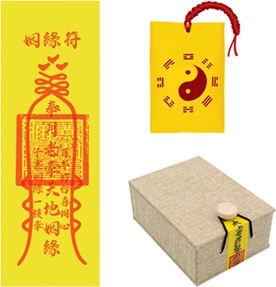 Tai Sui Yellow Amulet Paper FuLu Taoist Love Talisman Traditional Chinese Spiritual Charm Attracting Love Protecting Marriage